
Microgrids – Dynamic Pricing

Expected future demand for electric vehicles (EVs) is transforming energy demand patterns across the UK, as will the need for cost-effective, resilient, low-carbon charging infrastructure. Integration of EV charging, on-site renewable energy generation and dynamic electricity pricing is currently being considered as an optimum microgrid solution to maximise value derived from on-site energy generation.
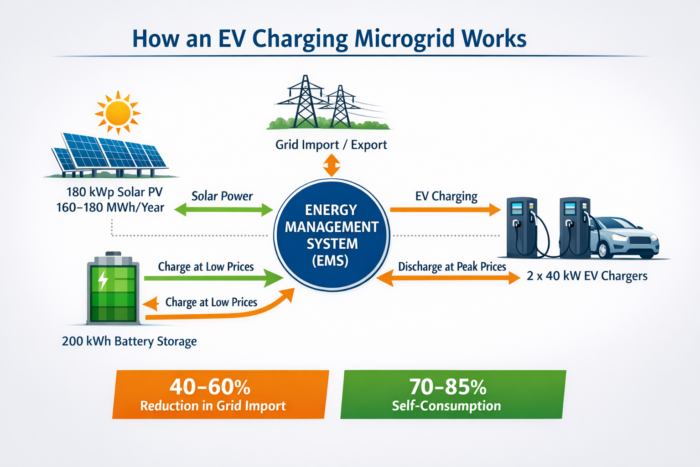
This insight summarises the operational, financial and strategic benefits of a typical microgrid system, comprising 180 kWp of solar photovoltaic (PV) generation, 200 kWh of battery storage and 2 x 40 kW DC EV chargers (80 kW total capacity), operating within a dynamic pricing model.
The microgrid infrastructure example combines three key technologies: solar PV panels, battery energy storage and EV charging infrastructure, coordinated via an intelligent energy management system (EMS). The system is also connected to the national grid, enabling electricity import and export, depending on operating and market pricing conditions.
“
Microgrids combining solar PV and battery storage can significantly cut dependence on grid electricity.
In our example the 180 kWp solar PV system generates approximately 160–180 MWh of electricity per annum. This energy is prioritised for on-site consumption, primarily supplying EV charging demand. When solar generation exceeds immediate demand, surplus energy is stored within the 200 kWh battery system rather than exported to the grid at (usually) lower than wholesale network prices.
Battery storage plays a critical role in optimising energy flows, charging EVs from either excess solar generation or during periods of low grid electricity prices, typically overnight or times of high renewable generation. The battery discharges during peak pricing periods or when EV charging demand is high, reducing grid import dependence.
The 40 kW DC EV chargers provide flexible, medium-speed charging suitable for workplace, fleet and destination charging options. With combined capacity of 80 kW, system utilisation rates for financial modelling typically assumes between 30% and 50%.
Dynamic pricing models, where electricity costs vary in real time based on wholesale market conditions, enables the microgrid facility to respond intelligently to market price signals, optimising both costs and revenues.
During low electricity pricing periods, the microgrid imports grid energy to directly charge the battery. Conversely, when prices are high, stored energy is used to supply EV charging demand or reduce grid imports. The process, energy arbitrage, creates additional value and supports microgrid financial models.
Importantly, dynamic pricing also supports EV charging tariff adjustment in response to energy costs and availability. For example, to encourage increased EV charging demand, lower charging prices are offered during high solar generation periods, while higher prices can be applied during peak periods when electricity pricing increases. This system attribute improves profitability and supports grid stability through incentivised demand-side flexibility.
Typically, the microgrid facility will produce approximately 170 MWh solar energy per annum. EV charging demand, depending on utilisation is expected to range between 100 and 140 MWh annually. This supply/demand balance enables a high level of on-site energy matching, with self-consumption rates of 70% to 85% expected.
Integrating battery storage with smart energy management systems reduces grid electricity import by 40% to 60% when compared to conventional EV charging facilities without on-site energy generation. Exported energy is therefore reduced, typically accounting for 10% to 20% total generation, maximising the value of locally produced renewable electricity.
Financial viability is underpinned by multiple revenue streams and associated cost-saving mechanisms.
The primary income source is EV charging. With typical UK charging tariffs ranging from £0.35 to £0.60 per kWh, annual revenues can range from £40,000 to £80,000 depending on site utilisation levels.
In addition to direct revenue, the microgrid will deliver significant energy cost savings by reduced reliance on grid electricity during peak pricing periods. These savings are typically valued at £20,000 to £40,000 per year.
Battery-enabled energy arbitrage provides a further £5,000 to £15,000 in annual value, depending on the electricity price volatility and EMS performance.
The potential to participate in grid network flexibility markets is also available, providing services including demand response or frequency regulation through network aggregators or system operator National Grid ESO. Active participation can in addition generate an additional £5,000 to £20,000 annually.
Overall, the system is capable of delivering a total annual value in the range of £70,000 to £150,000.
Capital costs for a similar microgrid system are estimated between £460,000 and £540,000, including solar PV carport, battery storage, EV charging infrastructure design, installation and commissioning. Capex costs result in a payback period of circa 4 years to 7 years, with internal rate of return (IRR) of between 12% to 22%, making microgrid solutions an attractive proposition for both investors and asset owners.
Beyond financial returns, microgrids offer several strategic advantages. The facility significantly reduces carbon emissions by prioritising renewable energy use, supports organisational net-zero targets and enhances environmental, social and governance (ESG) credentials.
Given fossil fuels commodity price volatility during Q1 2026, microgrids provide resilience against energy market price fluctuations, an increasingly important consideration. By generating and storing energy on-site, operators secure greater control over energy costs, reducing exposure to negative market conditions.
“
EV microgrids generate value through charging revenue, energy cost savings, energy arbitrage and grid services.
The modular nature of microgrids also enables future expansion. Additional EV chargers, battery capacity or renewable generation may be integrated as demand grows, ensuring long-term scalability benefits.
Despite the advantages presented, the microgrid model is not without risk. EV charger utilisation is a key determinant of financial performance, underutilised infrastructure will directly impact returns. Grid connection constraints, particularly export limitations imposed by distribution network operators (DNOs) may also negatively affect system design and operational boundary conditions.
Over time, solar PV panel and battery degradation also needs to be factored into long-term financial planning, together with changes in the UK Government’s energy policy, supply, export tariffs and market structures.
Integration of solar PV, battery storage and EV charging facilities within a dynamically priced microgrid represents a viable and flexible solution for future energy supply and directly supports the transport sector transition from fossil fuels. By optimising energy flows in real time and leveraging multiple value streams, microgrids can deliver satisfactory financial returns while supporting the transition to a low-carbon economy.
As EV adoption continues to grow and energy markets become increasingly dynamic, the microgrid model as described offers a scalable and resilient approach to infrastructure development, aligning economic performance with environmental sustainability.
If you are exploring EV charging infrastructure, on-site renewable generation or microgrid solutions incorporating dynamic pricing, contact us on +44 (0) 1382 657457 or email [email protected]. We would be pleased to help you assess feasibility, optimise system design and unlock the full commercial and operational value of your project.
Services (UK/International)


Electric Vehicle Charging Microgrids Incorporating Dynamic Pricing: A Scalabl...

The Future of Sustainable Outdoor Living Outdoor living is undergoing a qu...

The UK energy system is undergoing a structural shift. As the country acceler...

Turning Clean Energy Innovation into Bankable Projects The energy transiti...

Electric Vehicle Ultra-Fast Charging and Solar Carport Efficiencies Accele...

Securing UK Gas Supply While Scaling Up Clean Energy Managed Gas Transition ...