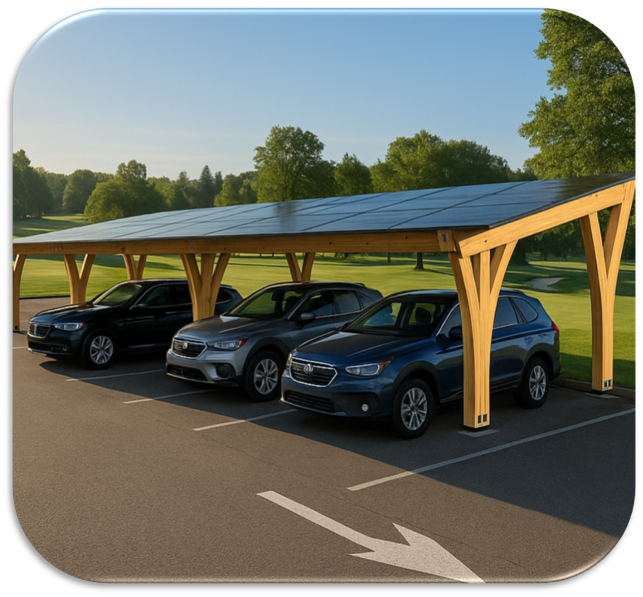
Timber-Based Solar PV Carports

Alan K MacLeod*, Yashodhara Bose*
*Project Engineering Group, Pure energy (REGen) Ltd, Finalists “Energy Project Award” – British Construction and Infrastructure Awards (BCIA), 2025
This briefing explores the potential of using glued-laminated timber (GLT) in solar photovoltaic (PV) carport construction as a sustainable alternative to steel. By reducing embodied carbon and serving as long-term carbon storage, timber structures can significantly lower greenhouse gas (GHG) emissions while offering aesthetic and fire-performance benefits. The briefing also considers the integration of ultra-fast electric vehicle (EV) charging, demonstrating how timber-based PV carports can support renewable energy deployment, improve grid efficiency and meet the growing demand for sustainable transport infrastructure.
The European Union (EU) is accelerating the energy transition away from fossil fuels through a mix of policy, regulation, investment and technological deployment. While progress varies by country and sector, the overall transition is trending toward expanded renewable energy deployment, stronger energy-efficiency measures and new market frameworks. In this context, Article 15c of the European Union’s Renewable Energy Directive (RED III) establishes renewable acceleration areas, requiring member states to prioritise artificial and built surfaces—such as rooftops and building façades, transport infrastructure and its immediate surroundings and parking areas.
In several European countries, binding legislation now mandates the incorporation of solar PV carports. In France, for example, solar PV carports are compulsory for both new and existing car parks (Legifrance, 2023). Similar legislation exists in Germany (The Institute for Climate Protection and Energy and Mobility, 2023), where the requirement applies to newly constructed parking areas.
In the United Kingdom, the accelerated uptake of electric vehicles (EVs) has necessitated substantial upgrades to transport infrastructure and placed increasing pressure on the national electricity grid. Ultra-fast charging—typically rated between 150 and 350 kW—has become a critical requirement for motorway service areas, fleet depots, logistics centres and high-throughput public charging hubs. Solar PV carports offer a practical solution for supplying renewable electricity locally, reducing reliance on the grid while supporting the sustainable expansion of EV charging infrastructure.
Concurrently, demand is growing for photovoltaic (PV) systems suited to urban environments, where limited rooftop availability and scarce open land restrict the deployment of conventional ground-mounted or rooftop PV installations.
What are the economic and environmental benefits of replacing conventional steel supporting structures with Glued laminated timber (GLT) structures in PV carport construction?
GLT is a structurally simple material, comprising wood, adhesive and surface treatment. This manufacturing method facilitates reuse or recycling at the end of initial service life, potentially extending the carbon storage period beyond the first use phase and further improving the material’s overall life-cycle performance.
GLT is also a well-established structural solution in the building industry (Wood Magazine, 2021) and has been successfully deployed in other infrastructure applications, including wooden buildings and bridges (Mitterpach et al., 2023). GLT structures therefore demonstrate robustness and long service lifetimes, making them a promising alternative for solar PV carport applications.
To date, PV carports have predominantly been constructed using steel, a material associated with a high carbon footprint and often perceived as aesthetically unappealing. In contrast, timber structures have the potential to act as long-term carbon stores, thereby reducing the overall greenhouse gas (GHG) emissions of solar PV systems. Despite this potential advantage, the environmental impacts and costs of PV supporting structures have received limited scholarly attention and the literature addressing these aspects remains sparse.
Solar photovoltaic (PV) technology is a key enabler of a sustainable, low-carbon energy system. In Nordic countries, where annual solar yields are lower than in equatorial regions and generation is concentrated primarily in the summer months, solar PV nevertheless remains an important component of renewable energy infrastructure. During summer periods, the complementary generation profiles of solar and wind power can jointly support a resilient and balanced renewable energy portfolio.
Previous research has highlighted the significance of PV support structures in determining overall system emissions. A study by Fahad and Gamalho Pereira (2015) found that PV support structures can account for a larger CO₂ footprint than the PV modules themselves. More recent studies have confirmed that substituting steel with timber in construction offers substantial climate-mitigation potential (Morris et al., 2021). Consequently, reducing both the environmental impact and cost of carport support structures represents a critical challenge for PV carport systems. Despite its importance, this topic remains comparatively under-researched, particularly for infrastructure-integrated PV systems, where support structures are typically heavier than those used in rooftop or ground-mounted installations.
Existing studies on solar PV carports have largely focused on system design, performance and optimisation (Ranta et al., 2022; Huerta et al., 2023), with limited emphasis on environmental assessment. Other analyses omit support structures altogether, concentrating instead on the greenhouse gas (GHG) reduction potential of PV modules alone.
A comparative assessment of glued-laminated timber (GLT) and conventional steel support structures illustrates the potential benefits of timber-based solutions. Li et al. (2023) modelled a 485 kWp PV carport system and reported base-case lifetime GHG emissions of 11.3 g CO₂-eq/kWh in Turku, Finland (60°N) and 8.2 g CO₂-eq/kWh in Dijon, France (47°N) for systems using wooden structures—representing a 48% reduction compared with steel-based alternatives. In addition, wooden structures were found to be economically competitive, with costs approximately 25% lower than those of steel structures.
Reported greenhouse gas (GHG) reductions are derived using a simplified life-cycle assessment (LCA) comparing two structural configurations for an identical photovoltaic (PV) carport system: (i) a conventional steel structure and (ii) a glued-laminated timber (GLT) structure. Functional units included within the analysis was 1 kWp of installed PV capacity, consistent with common PV life-cycle studies.
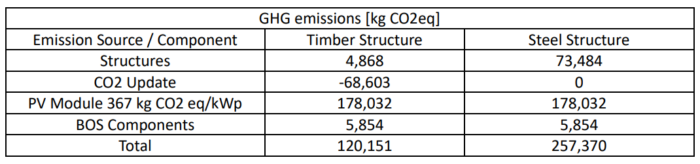
Two PV module emission factors were considered to reflect variability in manufacturing processes: 367 kg CO₂-eq/kWp (base case) and 550 kg CO₂-eq/kWp (worst case), values representative of crystalline-silicon PV manufacturing reported in recent literature (Qi Li et al., 2022). Structural material emissions were calculated using environmental product declaration data for engineered timber and structural steel (Lauri Linkosalmi et al., 2023).
Total system emissions included:
Using this approach, timber support structures were estimated to reduce total system emissions by approximately 53% in the base-case scenario compared with steel structures, see Table 1 below.
When the higher PV module emission factor is assumed, the reduction remains significant at around 40%, see table 2 below.
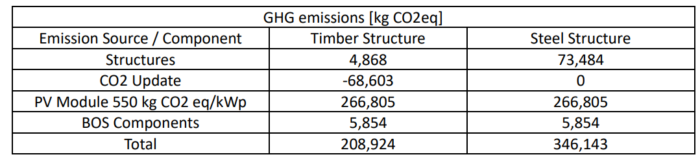
The substantially lower GHG emissions associated with timber-based solutions are primarily attributable to reduced embodied emissions during construction and to the capacity of wood to function as a long-term carbon storage pool. Timber products sequester biogenic carbon over the duration of their service life and can substitute more carbon-intensive materials, such as steel, thereby avoiding emissions associated with their production. The expected service life of timber-based structures is approximately 50 years, enabling carbon storage over extended periods.
Fire performance is an important consideration in structural design for PV carports. Engineered timber products such as GLT exhibit predictable fire behaviour due to the formation of a protective char layer during combustion, that acts as an insulating barrier, limiting oxygen supply and slowing heat penetration, which allows structural integrity to be maintained for longer durations.
Experimental studies indicate that structural timber typically chars at rates of approximately 0.6–0.8 mm per minute, enabling engineers to design timber members that retain structural capacity for defined fire-resistance periods; e.g., 30 mins, 60 mins etc. (American Wood Council, 2021).
By contrast, structural steel rapidly loses strength at elevated temperatures. Significant strength reduction begins in the range 400–500 °C and at approximately 600 °C steel may retain about 40–50% of its original strength (World Steel Association, 2021). As steel conducts heat efficiently, unprotected steel members may reach these temperatures within 10–15 minutes of fire exposure, potentially leading to structural instability. Hence steel structures commonly require additional fire-protection measures such as intumescent coatings or fire-resistant cladding. These protective treatments increase both material costs and embodied carbon emissions associated with steel construction.
Large engineered timber members can therefore achieve 30–60 minutes of fire resistance through inherent material behaviour, although appropriate electrical safety measures are also required in PV installations in order to mitigate ignition risks.
Achieving optimal performance from ultra-fast EV charging and solar PV carport systems requires an integrated energy-system design approach. Key considerations include:
When efficiently designed, integrated solar and EV charging infrastructure can defer or eliminate the need for grid reinforcement, accelerate project deployment and unlock additional revenue streams through flexibility and ancillary services, see Figure One (courtesy of Innoventum AB).
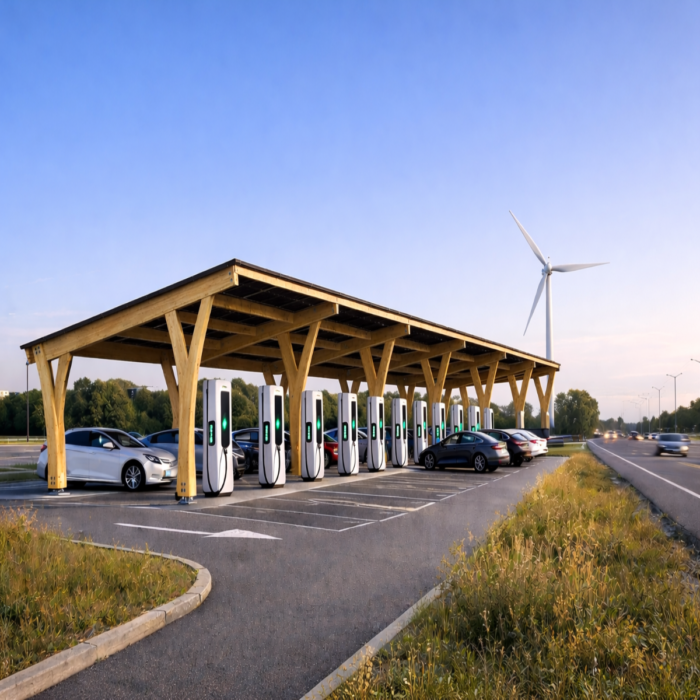
Ultra-fast EV charging enables vehicles to gain hundreds of miles of driving range within approximately 10–20 minutes, making electric mobility viable for long-distance travel, taxi services and commercial vehicle operations, However, such chargers are highly energy-intensive and can impose substantial peak loads on local electricity networks. For example, a single 300 kW charger can draw power equivalent to that of dozens of households operating simultaneously, creating challenges related to grid connection capacity, reinforcement costs and demand-based tariffs.
Without smart system integration, ultra-fast charging sites face elevated operational costs and potential deployment delays due to required grid upgrades. On-site renewable energy generation, combined with advanced energy management strategies, is therefore critical to ensuring both technical and economic feasibility.
Solar PV carports offer a dual-use solution by combining vehicle parking with photovoltaic electricity generation. Unlike ground-mounted systems, carports utilise existing paved surfaces, avoiding land-use conflicts and reducing planning constraints. Additional benefits include vehicle shading, weather protection and improved user experience.
From a performance perspective, solar carports can be optimally oriented and tilted to maximise energy yield, often outperforming rooftop installations constrained by shading or structural limitations. In commercial and public environments—such as retail parks, workplaces, transport hubs and fleet depots—carports enable large, contiguous PV arrays to be deployed close to points of electricity demand.
Solar PV carports provide an effective means of generating renewable electricity at the point of use, transforming underutilised brownfield spaces into productive energy assets. The results presented demonstrate substantial potential for greenhouse gas (GHG) emission reductions through the use of timber-based support structures in PV carport systems, with a 53% reduction in total emissions observed in the base-case scenario. This advantage is expected to increase over time as PV module efficiencies improve and embodied GHG emissions continue to decline.
Emerging third-generation photovoltaic technologies—such as organic and perovskite solar cells—also show strong potential to further reduce the carbon footprint of PV modules (Li et al., 2022). As a result, emissions associated with mounting and supporting structures are likely to account for an increasing share of total system emissions, underscoring the importance of optimising these components.
As EV adoption accelerates, the integration of ultra-fast charging with solar PV carports is expected to evolve from an innovation-led solution into a standard element of future-ready transport infrastructure. When combined with intelligent energy management systems, solar carports can deliver significant cost savings, carbon reductions and improvements in grid efficiency, benefiting site operators, users and the wider electricity network.
In particular, DC-to-DC ultra-fast charging architectures integrated with solar PV carports offer the potential for higher system efficiencies, reduced grid connection and reinforcement costs, improved charger performance and enhanced long-term economic returns. This approach has the capacity to transform EV charging from a grid-constrained load into a flexible, renewable-led energy asset.
Timber-frame structures provide additional advantages over steel alternatives. Timber prices are generally less exposed to global economic volatility, reducing supply-chain risks. Moreover, timber structures can offer improved fire performance, as steel rapidly loses structural integrity once critical temperatures are reached.
Finally, the rapid expansion of solar PV capacity presents a growing challenge in terms of public acceptance. Aesthetically pleasing solutions, such as timber-based PV carports can therefore play a critical role in improving visual integration and public support for large-scale renewable energy deployment.
We’re delighted to have been invited to contribute this insight as a briefing to the Institution of Civil Engineers (ICE) Member journal, Civil Engineering, following our recognition as finalists at the British Construction & Infrastructure Awards.
Contact us on +44 (0) 1382 657457 or email [email protected] to discuss how a wooden framed solar carport could transform your underutilised parking spaces into a sustainable, energy-generating asset.
Services (UK/International)



Advancing EnergyBox™ Towards Commercialisation From Climate Innovation to...

Supporting Woolwich Service Users Project on their Decarbonisation Journey ...
Reducing Emissions and Enabling Ultra-Fast EV Charging Alan K MacLeod*, Ya...
Pure energy (REGen) Ltd and its partners (Innoventum, Barlows, Immersa and Hy...
Pure energy (REGen) Ltd introduces the first solar PV microgrid product desig...
Electric Vehicle Charging Microgrids Incorporating Dynamic Pricing: A Scalabl...